

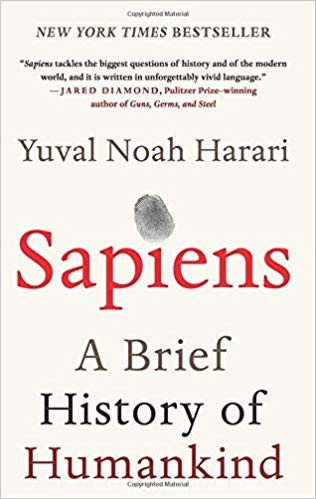

Introduction: The Book That Rewrites Everything
How do you write the history of an entire species in a single volume? How do you compress 70,000 years of human civilization — every war, every invention, every revolution, every love story — into fewer than 500 pages? And how do you do it in a way that is not only informative but genuinely thrilling to read? These are the seemingly impossible challenges that Yuval Noah Harari set for himself in Sapiens: A Brief History of Humankind, and by any reasonable measure, he succeeded spectacularly.
First published in Hebrew in 2011 and released in English in 2014, Sapiens has since sold over 25 million copies worldwide and been translated into more than 60 languages. It has been recommended by world leaders, tech billionaires, and Nobel laureates. It has spawned two sequels — Homo Deus and 21 Lessons for the 21st Century — and has fundamentally changed the way millions of people think about history, progress, and what it means to be human.
But Sapiens is not merely popular. It is provocative in the deepest sense of the word — it provokes thought, challenges assumptions, and forces readers to confront uncomfortable questions about the narratives they have been taught. Harari does not simply tell you what happened over the past 70,000 years. He asks you to reconsider whether what happened was good, whether it was inevitable, and whether it was even real in the way you think it was. The result is a book that reads less like a history and more like an intellectual earthquake.
"Sapiens is the sort of book that sweeps the cobwebs out of your head. It changed the way I think about the world." — Barack Obama, 44th President of the United States
About the Author: Yuval Noah Harari
Yuval Noah Harari was born in 1976 in Kiryat Ata, a small city near Haifa, Israel. He studied history at the Hebrew University of Jerusalem and completed his PhD at the University of Oxford, where he specialized in medieval and military history. His academic work focused on the relationship between history and biology, and on the concept of justice in warfare — subjects that would later inform the sweeping perspective of Sapiens.
Harari's path from obscure medieval historian to global public intellectual is itself a remarkable story. In 2010, he began teaching a course at the Hebrew University titled "A Brief History of Humankind." The course was recorded and posted online, where it attracted a massive audience — eventually prompting Harari to turn the material into a book. The Hebrew edition was published in 2011 and became a bestseller in Israel. The English translation, published by Harvill Secker in 2014, made Harari an international celebrity.
What distinguishes Harari from other popular historians is his willingness to make bold, sweeping claims and to follow his arguments to their logical — and often unsettling — conclusions. Where a more cautious historian might qualify every statement with caveats and counter-examples, Harari makes declarative claims that are designed to provoke. The Agricultural Revolution was "history's biggest fraud." Money is "the most universal and most efficient system of mutual trust ever devised." The notion of human rights is a fiction, no more objectively real than the gods of ancient Sumer. These claims are not always fair to the complexity of the evidence, but they are always interesting, and they force readers to think about familiar subjects in unfamiliar ways.
Harari is also an outspoken vegan and a dedicated practitioner of Vipassana meditation, retreating for a two-month silent meditation every year. These personal practices inform his writing in subtle but important ways. His emphasis on suffering — particularly the suffering of animals in industrial agriculture — reflects his Buddhist-influenced ethics. His ability to step back from conventional narratives and see human history from a cosmic perspective owes something to the detachment cultivated in meditation practice. Harari writes as someone who has trained himself to observe the human drama from the outside, and this outsider's perspective is one of the book's most distinctive and valuable qualities.
Summary by Part
Part One: The Cognitive Revolution (70,000 years ago)
Harari begins not at the beginning of human civilization but at a much earlier point: the moment, roughly 70,000 years ago, when Homo sapiens developed the cognitive abilities that would eventually allow it to dominate the planet. Before the Cognitive Revolution, there were several human species coexisting on Earth — Neanderthals in Europe, Homo erectus in Asia, the diminutive Homo floresiensis on the island of Flores. Sapiens was just one of many. After the Cognitive Revolution, there was only us.
What changed? Harari argues that the key development was the ability to create and believe in fictions — shared myths, stories, and beliefs that exist only in human imagination. Other animals can communicate about concrete realities: a monkey can warn its troop about a lion, and a bee can tell other bees where to find nectar. But only Sapiens can talk about things that do not exist — gods, nations, human rights, money, corporations, laws. This ability to create and share fictions is what allowed Sapiens to cooperate in large numbers. A chimpanzee troop cannot exceed about 150 individuals because chimpanzees can only maintain social bonds through personal acquaintance. But Sapiens, bound together by shared myths, can cooperate in groups of millions.
This is one of Harari's most important and most controversial ideas. He is not using "fiction" pejoratively. He is not saying that religion, law, or money are lies. He is saying that they are inter-subjective realities — things that exist because enough people believe in them, and that cease to exist when people stop believing. A dollar bill is objectively a piece of paper. It becomes money only because millions of people share a fiction about its value. The United States of America is not an objective feature of the landscape. It is a story that 330 million people agree to tell and act upon. These fictions are immensely powerful — powerful enough to build civilizations, launch crusades, and send rockets to the moon. But they are fictions nonetheless, and recognizing them as such is, Harari argues, essential to understanding human history.
Part Two: The Agricultural Revolution (12,000 years ago)
If the Cognitive Revolution is the hero of Harari's narrative, the Agricultural Revolution is the villain — or at least the tragic mistake. Harari's treatment of the transition from foraging to farming is perhaps the most provocative section of the book. Conventional wisdom presents agriculture as a great leap forward — the moment when humans stopped wandering and started building civilization. Harari turns this narrative on its head, arguing that the Agricultural Revolution was "history's biggest fraud."
Before agriculture, Harari argues, foragers lived relatively good lives. They worked fewer hours than farmers, ate a more varied and nutritious diet, and suffered from fewer diseases. They lived in small, egalitarian bands and had extensive knowledge of the natural world. Agriculture changed all of this. Farmers worked longer hours for less nutritious food. They lived in crowded settlements where diseases could spread easily. They became dependent on a handful of crops — wheat, rice, corn — that made them vulnerable to famine. And the social hierarchies that agriculture enabled — kings, priests, landlords, slaves — introduced forms of inequality and oppression that foragers had never known.
Harari's most striking claim is that humans did not domesticate wheat; wheat domesticated humans. Before agriculture, Homo sapiens was a free-ranging species that lived wherever it pleased and ate whatever it found. After agriculture, humans became servants of their crops, spending their days plowing, planting, weeding, and harvesting in the service of plants that could not survive without human care. From wheat's perspective, the Agricultural Revolution was a spectacular success — the plant went from a wild grass growing on a few hillsides in the Middle East to one of the most widespread species on the planet. From the human perspective, the revolution was more ambiguous. We got civilization, but we also got slavery, warfare, famine, and epidemic disease.
Part Three: The Unification of Humankind
The third section of Sapiens traces the gradual process by which thousands of small, independent human cultures were absorbed into a handful of large civilizations, and eventually into a single global civilization. Harari identifies three great unifying forces: money, empire, and religion. Each of these is a fiction — a shared story that allows large numbers of strangers to cooperate — and each has played a crucial role in binding humanity into an increasingly interconnected whole.
Money, Harari argues, is the most successful fiction ever created. It is a system of mutual trust that works across cultural and linguistic boundaries. Two people who share no language, no religion, and no cultural values can nevertheless do business because they both believe in the value of gold, dollars, or bitcoin. This universality makes money more powerful than any other human invention. It breaks down barriers that would otherwise be insurmountable, enabling cooperation between people who might otherwise be enemies.
Empire, despite its bloody history, has been a powerful force for cultural unification. The Roman Empire, the Chinese Empire, the British Empire — each absorbed diverse populations into a common cultural framework, spreading languages, laws, technologies, and ideas across vast territories. Harari is careful not to romanticize empire. He acknowledges the violence, exploitation, and cultural destruction that empires have inflicted. But he also argues that many of the things we value most — legal systems, road networks, linguistic unity, scientific traditions — are products of imperial rule. This is an uncomfortable argument, and Harari does not shy away from its implications.
Religion, the third unifying force, has evolved from animistic beliefs shared by small bands of foragers to universal religions — Christianity, Islam, Buddhism — that claim relevance for all humanity. Harari traces this evolution with characteristic boldness, treating all religions as human creations rather than divine revelations. His analysis of how religions spread, adapt, and enforce social order is one of the book's most illuminating sections, drawing on anthropology, psychology, and comparative religion to show how shared beliefs create shared behavior on a massive scale.
Part Four: The Scientific Revolution (500 years ago)
The final section of Sapiens is devoted to the Scientific Revolution, which Harari dates to approximately 1500 CE. Before the Scientific Revolution, human civilizations grew and changed, but they did so slowly and without any expectation that the future would be fundamentally different from the past. The Scientific Revolution introduced a new idea: that humanity could increase its capabilities through systematic research and discovery, and that the future could be not just different from the past but radically better.
Harari identifies three key features of the Scientific Revolution. First, the admission of ignorance — the recognition that there are important things we do not know and that our current knowledge may be wrong. This seems obvious today, but it was genuinely revolutionary in a world where knowledge was derived from scripture and tradition. Second, the centrality of observation and mathematics — the idea that knowledge should be based on empirical evidence organized through mathematical models. Third, the acquisition of new powers — the marriage of scientific knowledge and technological capability that has given humanity the power to reshape the world.
The Scientific Revolution, Harari argues, is inextricably linked to European imperialism and capitalism. Science provided the knowledge that made conquest possible, while empire and capitalism provided the resources and incentives that funded scientific research. This unholy trinity — science, empire, and capitalism — has shaped the modern world, for better and for worse. It has produced antibiotics and atom bombs, democracy and drone warfare, the internet and industrial farming. Harari does not attempt to render a final verdict on whether the net effect has been positive or negative. He simply presents the evidence and lets the reader decide.
Key Arguments
The Fiction Thesis
Harari's most important and most original argument is what might be called the Fiction Thesis: the idea that Homo sapiens rules the world because it is the only species that can believe in things that exist purely in its imagination. Money, nations, corporations, human rights, gods — all of these are fictions, inter-subjective realities that exist only because large numbers of people believe in them. This ability to create and share fictions is, Harari argues, the secret of our species' success. It is what allows millions of strangers to cooperate, what makes complex societies possible, and what distinguishes us from every other animal on the planet.
The Fiction Thesis is both liberating and disturbing. It is liberating because it reveals the contingency of our social arrangements. If money is a fiction, then the rules of the economy are not laws of nature but conventions that can be changed. If nations are fictions, then borders are not immutable facts but lines drawn by human agreement. If human rights are fictions, then their scope and content can be expanded or contracted as we see fit. Everything that seems natural and inevitable is actually artificial and changeable.
But the Fiction Thesis is also disturbing because it undermines the foundations of many of our most cherished beliefs. If human rights are fictions, then what grounds our commitment to equality and justice? If morality is a collective myth, then how do we justify the claim that some things are truly right and others truly wrong? Harari does not fully answer these questions, and critics have accused him of a kind of philosophical nihilism — tearing down the foundations of human values without offering anything to replace them.
The Happiness Question
One of the most thought-provoking sections of Sapiens deals with the question of happiness. Harari asks: Has all of human progress — from the Agricultural Revolution to the Scientific Revolution to the Information Age — actually made people happier? His answer, based on a survey of the available evidence, is a tentative no. Studies suggest that happiness depends more on subjective expectations and neurochemistry than on objective conditions. A medieval peasant with a strong community and a rich spiritual life may have been happier than a modern office worker with air conditioning, antibiotics, and Netflix. This is not a romanticization of the past — Harari acknowledges that medieval life was brutal in many ways. It is simply an observation that material progress and psychological well-being are not as tightly correlated as we tend to assume.
This argument challenges the most fundamental assumption of modern civilization: that progress makes life better. If thousands of years of agricultural, industrial, and technological development have not made us significantly happier, then what has all the effort been for? Harari does not provide a definitive answer, but the question itself is transformative. It forces us to ask what we mean by "better" and whether the metrics we use to measure progress — GDP, life expectancy, technological capability — are actually capturing what matters most.
"I would recommend Sapiens to anyone interested in the history and future of our species." — Bill Gates, co-founder of Microsoft
Major Themes
The Power of Collective Myth
The central theme of Sapiens is the power of collective myth to shape human behavior and history. Every large-scale human institution — from the ancient Egyptian pharaonic state to the modern multinational corporation — depends on shared fictions for its existence. The pharaoh's power rested on the collective belief that he was a god. The corporation's power rests on the collective belief that it is a legal entity with rights and obligations. Neither the pharaoh's divinity nor the corporation's legal personality is an objective fact. Both are stories that people agree to treat as real.
Harari argues that the ability to change our collective myths is what makes human history dynamic. Other animals are constrained by their biology — their behavior changes only through the slow process of genetic evolution. Humans can change their behavior overnight by adopting a new story. When the French stopped believing in the divine right of kings and started believing in the sovereignty of the people, the entire structure of their society changed — not because of any biological mutation but because of a shift in the collective imagination. This is the secret of our species' remarkable adaptability: we can rewrite the software of our civilization without touching the hardware of our biology.
The Cost of Progress
Another major theme is the hidden costs of what we call progress. The Agricultural Revolution made civilization possible but also introduced warfare, inequality, and environmental destruction. The Industrial Revolution raised material living standards but also created factory labor, urban squalor, and the conditions for total war. The Information Revolution has connected the world but also enabled surveillance, misinformation, and new forms of addiction. At every stage, Harari argues, progress has been a mixed blessing — solving some problems while creating new ones, often worse than the ones it solved.
This is not a pessimistic argument. Harari does not claim that all progress is illusory or that we would be better off returning to the Stone Age. He simply insists that we should be honest about the costs of progress and not assume that every change is automatically an improvement. This clear-eyed assessment is one of the book's most valuable contributions, offering a corrective to the naive techno-optimism that dominates much contemporary discourse about innovation and disruption.
The Fate of Other Species
One of the most sobering themes in Sapiens is Harari's account of what human success has meant for other species. The arrival of Homo sapiens in Australia 45,000 years ago led to the extinction of most of the continent's megafauna within a few thousand years. The same pattern repeated in the Americas, in Madagascar, and in New Zealand. Wherever Sapiens went, large animals disappeared. And the process has only accelerated with industrialization. Today, livestock animals — cows, pigs, and chickens — account for the overwhelming majority of large animal biomass on Earth. Wild animals, which once dominated the planet, have been reduced to a tiny fraction.
Harari does not moralize about this directly, but his account of industrial animal farming is devastating in its matter-of-fact description of suffering. He describes the lives of factory-farmed animals — their confinement, their mutilations, their separation from their young — and notes that this may be the greatest crime in human history, one perpetrated against billions of sentient beings every year. Coming from a historian who has just described the horrors of war, slavery, and genocide, this claim carries considerable weight.
Controversies and Criticisms
Sapiens has been widely praised, but it has also attracted significant criticism from specialists in the fields Harari covers. Anthropologists have challenged his portrayal of forager societies as peaceful and egalitarian, noting that the evidence is more mixed than he suggests. Economists have disputed his characterization of capitalism, arguing that he oversimplifies the relationship between markets and imperialism. Philosophers have accused him of logical inconsistency, noting that he claims all values are fictions while simultaneously making moral judgments that presuppose the reality of values like fairness and compassion.
The most common criticism is that Harari sacrifices accuracy for readability, making sweeping claims that are not adequately supported by the evidence. His assertion that the Agricultural Revolution was "history's biggest fraud" is a case in point. While there is evidence that early farmers were less healthy than their forager ancestors, the picture is considerably more complex than Harari presents it. Some populations adapted quickly to agricultural diets, and the transition was not universally negative. By presenting a simplified version of a complex reality, Harari makes a memorable argument at the cost of nuance.
Another criticism concerns Harari's treatment of religion. By treating all religions as human-created fictions, he alienates readers who believe that their faith reflects genuine divine revelation. More importantly, critics argue, he fails to take seriously the possibility that religious experience — whatever its ultimate source — might provide genuine insight into the nature of reality. Harari treats religion purely as a social phenomenon, a tool for organizing large groups of people, and this reductive approach misses much of what makes religion meaningful to its practitioners.
Despite these criticisms, even Harari's detractors generally acknowledge that Sapiens is a remarkable achievement. No single book can do justice to 70,000 years of human history, and any attempt to do so will necessarily involve simplification and omission. The question is not whether Harari gets everything right — he does not, and he would probably be the first to admit it. The question is whether his grand narrative is useful, and on this point the evidence is clear: millions of readers have found Sapiens to be one of the most thought-provoking books they have ever read.
"I've read Sapiens a couple of times and always come away with new insights. It's a book that makes you think differently about everything." — Mark Zuckerberg, CEO of Meta
The Animal Question
One of the most provocative and emotionally charged sections of Sapiens deals with the treatment of animals in human history, particularly in the era of industrial farming. Harari argues that the domestication of animals was a catastrophe — not for humans, who gained a reliable source of food and labor, but for the animals themselves, who were transformed from free-living creatures into commodities, their every biological function subordinated to human needs.
Harari's description of the lives of factory-farmed animals is deliberately disturbing. He describes the confinement of laying hens in battery cages so small they cannot spread their wings, the separation of dairy calves from their mothers within hours of birth, the castration and tail-docking of piglets without anesthesia, and the genetic engineering of chickens so top-heavy with breast meat that they can barely stand. He presents these facts without rhetorical flourish, letting the details speak for themselves, and the effect is devastating.
Harari's conclusion — that industrial animal farming may be the greatest crime in human history — is one of the book's most controversial claims. It is controversial not because the facts are in dispute but because of the moral weight Harari attaches to them. By placing animal suffering alongside human atrocities like slavery and genocide, he challenges the anthropocentric worldview that has dominated Western thought since Aristotle — the view that human interests are categorically more important than animal interests, and that the suffering of animals is, at best, a secondary moral concern.
This section of the book has been particularly influential among readers who went on to reduce or eliminate their consumption of animal products. Harari himself is a vegan, and while he does not explicitly advocate veganism in Sapiens, his account of industrial farming provides some of the most compelling arguments for it. By placing the treatment of animals within the broader context of human history — showing how the same cognitive and organizational capabilities that built civilizations also created factory farms — Harari forces readers to confront the moral implications of their daily choices in a way that purely ethical arguments often fail to do.
Money, Empire, and Religion: The Three Great Unifiers
Harari devotes significant attention to the three forces that, in his analysis, have driven the gradual unification of humanity into a single global civilization: money, empire, and religion. Each of these is, in Harari's terms, an "imagined order" — a system of beliefs and practices that exists only because large numbers of people agree to treat it as real. But each operates differently, and understanding how they work is essential to understanding the world we live in.
Money, Harari argues, is the most universal of the three. Unlike religion or empire, which require some degree of shared culture or shared values, money works across every cultural boundary. Two people who worship different gods, speak different languages, and hold mutually incompatible political beliefs can nevertheless conduct business because they both believe in the value of gold or dollars. Money is, in Harari's memorable phrase, "the most universal and most efficient system of mutual trust ever devised." It is also, he notes, one of the most tolerant: the money system does not require you to believe in any particular god, embrace any particular values, or belong to any particular community. It only requires you to believe that the money itself has value — and everyone does.
Empire, by contrast, operates through power rather than consent. Empires expand by conquering diverse populations and integrating them into a common political and cultural framework. This process is inevitably violent — no people in history has voluntarily surrendered its sovereignty — but it is also, Harari argues, genuinely creative. Imperial rule brings diverse populations into contact with one another, facilitating the exchange of ideas, technologies, and cultural practices that would not otherwise occur. The Greek Empire spread philosophy, the Roman Empire spread law, the Chinese Empire spread bureaucracy, and the British Empire spread the English language. These contributions do not justify the violence of imperial conquest, but they do complicate the simplistic narrative that empire is purely destructive.
Religion, the third unifying force, provides something that neither money nor empire can: meaning. Money tells you what things are worth. Empire tells you who is in charge. Religion tells you why you exist, how you should live, and what happens after you die. These are the questions that matter most to most people, and the religions that answer them most persuasively — Christianity, Islam, Buddhism, Hinduism — have become the world's most powerful institutions, commanding the loyalty of billions of people and shaping the course of history in ways that no emperor or banker can match.
The Future of Sapiens: Looking Forward
The final pages of Sapiens venture into territory that Harari would explore more fully in his sequel, Homo Deus: the future of the human species. Harari argues that we are on the verge of transformations that dwarf anything in our 70,000-year history. Genetic engineering, artificial intelligence, and cyborg technology may soon give us the power to redesign Homo sapiens itself — to create beings with capabilities that natural selection never dreamed of. We may be the last generation of Homo sapiens as we know it.
This is a startling claim, but Harari makes it with the same calm, analytical tone that characterizes the rest of the book. He does not present the future as utopian or dystopian. He presents it as a continuation of the same processes that have shaped human history from the beginning: the interplay of biology and culture, the power of collective fictions, and the unintended consequences of technological innovation. The Agricultural Revolution transformed us in ways that the first farmers never anticipated. The Industrial Revolution did the same. There is no reason to think that the Biotechnological Revolution will be any different.
What makes Harari's vision of the future so provocative is his insistence that the key question is not "What will we be able to do?" but "What will we want to do?" We may soon have the ability to engineer super-intelligent, immortal beings. But who decides what these beings should look like? Who determines the values they should hold? Who controls the technology that creates them? These are not scientific questions. They are political, ethical, and philosophical questions, and Harari argues that we are profoundly unprepared to answer them.
This concern about the gap between our technological capabilities and our ethical preparedness is one of Sapiens' most important contributions to contemporary discourse. In an age of rapid technological change, when decisions made by a handful of engineers and entrepreneurs can reshape the lives of billions, Harari's insistence that we think carefully about what we want — not just what we can do — is more urgent than ever. Sapiens does not tell us what the future should look like. It tells us that we need to start thinking about it seriously, before the decisions are made for us by forces we do not understand and cannot control.
The Cognitive Revolution in Detail
The first section of Sapiens, devoted to the Cognitive Revolution, deserves closer examination because it contains Harari's most original and far-reaching argument. Before approximately 70,000 years ago, Homo sapiens was an unremarkable species — one of several human species coexisting on Earth, with no special claim to dominance. Neanderthals had larger brains and were better adapted to cold climates. Homo erectus had survived for nearly two million years, making it one of the most successful species in the history of life. Homo sapiens, by contrast, was a relative newcomer, confined to a small corner of Africa and showing no signs of the world-conquering potential it would later display.
What changed? Harari argues that a genetic mutation — probably affecting the internal structure of the brain — gave Sapiens unprecedented cognitive abilities, including the ability to think about things that do not exist. This capacity for fiction — for imagining gods, spirits, nations, and laws — was the key that unlocked everything else. Other animals can communicate about concrete realities: a vervet monkey can make different alarm calls for different predators, essentially saying "Careful! A lion!" or "Careful! An eagle!" But no vervet monkey has ever said "A lion is the guardian spirit of our tribe" or "If you violate our taboo, the lion spirit will punish you."
This ability to create and share fictions enabled Sapiens to cooperate in large numbers with strangers — something no other animal can do. Chimpanzees cooperate in groups of up to about 50 individuals, all of whom know each other personally. Wolves cooperate in packs of up to about 20. But Sapiens, united by shared myths, can cooperate in groups of millions. The Catholic Church, the United States of America, and Google are all, in Harari's analysis, cooperation networks held together by shared fictions. They exist because millions of people believe in the same stories about God, about human rights, or about the value of stock options.
The implications of this argument are staggering. If large-scale human cooperation depends on shared fictions, then the stability of our institutions depends on our continued willingness to believe in those fictions. Democracy works as long as enough people believe in it. The economy functions as long as enough people trust in money. Human rights exist as long as enough people agree that they exist. None of these things are objective facts of nature, like the speed of light or the atomic weight of carbon. They are collective agreements that can be changed, abandoned, or replaced — and the history of civilization, in Harari's telling, is largely the history of these agreements being changed, abandoned, and replaced.
Comparing Sapiens to Other Big-History Books
Harari is not the first writer to attempt a comprehensive history of the human species. Jared Diamond's Guns, Germs, and Steel (1997) covered similar ground, focusing on how geography and environment shaped the destinies of different civilizations. David Christian's Maps of Time (2004) went even further, placing human history within the context of the entire history of the universe. And Steven Pinker's The Better Angels of Our Nature (2011) offered a more optimistic account of human progress, arguing that violence has declined dramatically over time.
What distinguishes Sapiens from these predecessors is Harari's willingness to make philosophical arguments, not just empirical ones. Diamond, Christian, and Pinker are primarily concerned with what happened and why. Harari is equally concerned with what it meant and whether it was worth it. His chapters on happiness, on the treatment of animals, and on the fictional nature of human institutions go beyond historical narration into philosophical territory that most big-history writers avoid. This philosophical dimension is what gives Sapiens its distinctive flavor and what makes it more than just another survey of human history.
At the same time, this philosophical ambition is the source of many of the criticisms leveled at the book. Philosophers have complained that Harari's arguments are not rigorous enough, that he makes claims without adequate justification, and that he conflates different senses of words like "fiction" and "myth." Historians have objected that he cherry-picks evidence to support his arguments and ignores counter-examples that would complicate his narrative. These criticisms are valid, but they also reflect the inherent tension in any attempt to write a book that is both a history and a philosophy — a tension that Harari navigates imperfectly but courageously.
The Book's Relationship to Contemporary Debates
Sapiens has become a touchstone in several ongoing intellectual debates. Its argument about the fictional nature of human institutions has been cited in discussions about cryptocurrency, which can be seen as a new form of the "intersubjective fiction" of money. Its analysis of the Agricultural Revolution has influenced debates about diet and nutrition, with paleo diet advocates pointing to Harari's portrait of pre-agricultural health as support for their claims. And its discussion of the Scientific Revolution has been used in arguments about the relationship between science, capitalism, and imperialism — a relationship that remains deeply contested.
Perhaps most significantly, Sapiens has contributed to the growing debate about artificial intelligence and the future of work. Harari's argument that large-scale human cooperation depends on shared fictions raises profound questions about what happens when AI systems can participate in — or even create — these fictions. If money is a fiction that enables cooperation, what happens when algorithms can create and manipulate financial fictions more effectively than humans? If nations are fictions held together by shared stories, what happens when AI can generate stories more persuasive than any human storyteller? These questions, implicit in Sapiens and explicit in Homo Deus, are becoming more urgent with every passing year.
Harari himself has become one of the most prominent public intellectuals engaging with these questions. His TED talks, his articles in the New York Times and the Guardian, and his conversations with world leaders have made him a central figure in global discussions about technology, politics, and the future of humanity. It is difficult to think of another historian who has achieved this kind of influence in the contemporary public sphere, and much of that influence traces directly back to the ideas first articulated in Sapiens.
Writing Style
One of the keys to Sapiens' success is Harari's writing style, which manages to be simultaneously accessible and intellectually serious. He writes in clear, jargon-free prose that any educated reader can follow, but he does not dumb down his arguments or avoid complexity. He uses vivid examples, memorable analogies, and occasional humor to bring abstract ideas to life. When he describes the Agricultural Revolution as a "fraud" perpetrated by wheat on unsuspecting humans, or when he compares the modern corporation to an ancient temple, he is using the tools of popular writing to communicate ideas that academic historians have struggled to make interesting.
Harari is also a master of the provocative question. Throughout Sapiens, he poses questions that seem simple but open onto vast philosophical depths. Is there an objective difference between a witch doctor and a neurosurgeon? Can a corporation suffer? Is money a religion? These questions are designed to unsettle, to shake readers out of their habitual ways of thinking and force them to look at familiar realities from unfamiliar angles. Not every question receives a satisfying answer, but the act of asking them is itself valuable.
The book's structure also contributes to its readability. Each of the four parts focuses on a different revolution — Cognitive, Agricultural, Unification, Scientific — and each builds on the ones before. Within each part, Harari moves between narrative, argument, and speculation, keeping the reader engaged by constantly shifting modes. Just when a section of dense analysis threatens to become tedious, Harari introduces a vivid anecdote or a startling comparison that brings the argument back to life. This structural skill is one of the things that distinguishes Sapiens from the many other big-history books that have been published in recent years.
Cultural Impact
The cultural impact of Sapiens extends far beyond the publishing world. It has influenced policy discussions about artificial intelligence, climate change, and economic inequality. It has been cited in academic papers across dozens of disciplines, from anthropology to management studies to computer science. It has been featured in courses at universities around the world and has become a standard reference in debates about the future of humanity.
In Silicon Valley, Sapiens has achieved something close to canonical status. Tech leaders cite it as one of the books that most influenced their thinking, and its ideas about collective fictions, technological disruption, and the future of work have become part of the standard vocabulary of tech culture. This is partly because Harari's themes resonate with the tech industry's self-image as a force for radical transformation, and partly because Harari, unlike many historians, takes technology seriously as a driver of historical change.
The book has also sparked a broader cultural conversation about grand narratives. For decades, historians have been moving away from big stories — the rise of civilization, the march of progress — and toward smaller, more localized accounts. Sapiens represents a deliberate return to the grand narrative tradition, and its commercial success has shown that there is a massive audience for big-picture thinking about the human story. Whether this is a welcome development or a retrograde one depends on your perspective, but there is no denying that Harari has changed the conversation about what history can and should be.
Reading Sapiens as a Companion to the Present
One of the most valuable aspects of Sapiens is its ability to reframe contemporary issues in historical perspective. Consider the debate about inequality. Harari shows that economic and social inequality are not modern phenomena but have been features of human societies since the Agricultural Revolution. The first farmers created surpluses that could be hoarded, leading to the emergence of elites who controlled resources and labor. Every subsequent society has found new ways to justify and maintain inequality — through religion, through law, through ideology. Understanding this history does not resolve the contemporary debate about inequality, but it does add depth to it, showing that the patterns we observe today have roots that stretch back thousands of years.
Or consider the debate about technology. Harari's account of the Scientific Revolution shows that technological innovation has always been a double-edged sword — creating new possibilities while also creating new problems. The same dynamic that gave us antibiotics and smartphones also gave us nuclear weapons and climate change. Recognizing this pattern does not mean that we should reject technology, but it does suggest that we should be more thoughtful about how we develop and deploy it. Every technology creates winners and losers, and the distribution of costs and benefits is never equal.
Or consider the debate about identity. Harari's argument that nations, ethnicities, and even genders are social constructions — fictions that have been agreed upon by large numbers of people — challenges the essentialist view of identity that underlies much contemporary discourse. If national identity is a fiction, then the boundaries between "us" and "them" are not natural facts but human choices that can be changed. This is a liberating insight, but it is also a destabilizing one, because it undermines the foundations of the very communities that give people a sense of belonging and purpose.
In each of these cases, Sapiens does not provide answers. It provides perspective — the kind of long-view, big-picture perspective that is essential for navigating the complexities of the present but that is increasingly rare in a culture dominated by news cycles, social media, and the tyranny of the immediate. Harari himself has said that the purpose of history is not to predict the future but to free us from the past — to show us that things did not have to be the way they are, and therefore do not have to remain the way they are. This is the deepest value of Sapiens: not the information it conveys but the freedom it offers.
How Sapiens Changed the Way We Talk About History
Before Sapiens, big-picture history was a niche genre — the domain of specialists like Jared Diamond and David Christian, whose books were respected but rarely became mainstream bestsellers. Harari changed this, demonstrating that there was a massive, underserved audience for grand-narrative history written in accessible, engaging prose. The success of Sapiens opened the door for a wave of similar books — from David Graeber and David Wengrow's The Dawn of Everything to Peter Frankopan's The Silk Roads — that attempt to tell the human story from a new angle.
Harari also changed the way people talk about history in everyday conversation. Before Sapiens, it was unusual for non-specialists to discuss the Cognitive Revolution, the Agricultural Revolution, or the concept of imagined orders over dinner. After Sapiens, these terms entered the general vocabulary of educated discourse, appearing in podcasts, TED talks, newspaper columns, and corporate strategy sessions. Harari gave people a new set of concepts for thinking about the world, and these concepts have proven remarkably durable.
Perhaps most importantly, Sapiens changed the emotional register of popular history. Before Harari, popular history tended to be either celebratory (the march of progress, the triumphs of civilization) or cautionary (the horrors of war, the crimes of empire). Harari introduced a third register: philosophical detachment. He examines human history with the curiosity of an anthropologist studying an alien species, noting patterns, identifying contradictions, and asking questions that a more conventionally engaged historian might not think to ask. This detached perspective can feel cold — Harari sometimes seems to view human suffering with the same dispassionate interest that a biologist brings to the study of ant colonies — but it also yields insights that a more emotionally engaged approach would miss.
The question of whether Harari's detachment is a strength or a weakness depends on what you think history is for. If history is meant to inspire, to provide moral lessons, to strengthen our commitment to particular values, then Harari's detachment is problematic — it undermines the very values it examines. But if history is meant to illuminate, to reveal the hidden structures that shape our lives, to make the familiar strange so that we can see it more clearly, then Harari's detachment is essential. It is what allows him to ask the questions that no one else is asking, and it is what makes Sapiens not just another history book but a genuinely original contribution to the way we understand ourselves.
The Book's Limitations
No review of Sapiens would be complete without a frank acknowledgment of its limitations. The book's greatest strength — its ambition — is also its greatest vulnerability. By attempting to cover 70,000 years of human history in a single volume, Harari inevitably simplifies, generalizes, and, in some cases, distorts. Individual chapters of Sapiens cover subjects that other scholars have devoted entire careers to studying, and no single book can do justice to all of them.
The most significant limitation is the book's Eurocentrism. Despite its subtitle, Sapiens devotes disproportionate attention to European history, particularly in its treatment of the Scientific Revolution, imperialism, and capitalism. Non-European civilizations — China, India, the Islamic world, sub-Saharan Africa, the pre-Columbian Americas — receive comparatively little attention, and when they do appear, they are often presented through a European lens. This is a common problem in big-history writing, and Harari is not the worst offender, but it is a limitation that readers should be aware of.
Another limitation is the book's reliance on broad generalizations that, while thought-provoking, are sometimes misleading. The claim that the Agricultural Revolution was "history's biggest fraud" is a memorable sound bite, but it does not do justice to the complexity and variability of the transition from foraging to farming, which played out differently in different parts of the world over thousands of years. Similarly, the claim that happiness has not increased with material progress, while supported by some evidence, oversimplifies a complex body of research that points in multiple directions.
These limitations do not invalidate the book's achievements, but they do suggest that Sapiens should be read as a provocation rather than a textbook — as a starting point for further reading and thinking, not as the final word on any of the subjects it covers. Harari himself has acknowledged this, noting that the book is meant to raise questions, not to settle them. The reader who takes Sapiens as gospel is misreading it. The reader who takes it as an invitation to think more deeply about the human story is reading it exactly as Harari intended.
Why You Should Read It Today
In a world of increasing specialization, where experts know more and more about less and less, Sapiens offers something rare: a broad view. It pulls back the camera from the daily noise of politics, economics, and technology and shows us the full sweep of human history — the patterns that recur, the revolutions that transform, and the fictions that hold everything together. This kind of big-picture thinking is not just intellectually satisfying; it is practically necessary. Many of the challenges we face today — climate change, artificial intelligence, global inequality — are products of the long historical processes that Harari describes, and they cannot be understood, much less addressed, without the kind of historical perspective that Sapiens provides.
Read it to understand where we came from. Read it to question where we are going. Read it to challenge your assumptions about what is natural, what is inevitable, and what is merely a story we have agreed to tell ourselves. You may not agree with everything Harari says — indeed, you probably should not agree with everything he says. But you will think differently after reading this book, and that, more than anything, is what makes it worth your time.
Conclusion
Frequently Asked Questions About Sapiens
Is Sapiens accurate?
This is perhaps the most common question about the book, and the answer is nuanced. At the broadest level, Harari's account of human history is supported by mainstream science and scholarship. The Cognitive Revolution, the Agricultural Revolution, the rise of empires, and the Scientific Revolution are all well-documented phenomena, and Harari's general account of each is consistent with the scholarly consensus. However, many of his specific claims — particularly his more provocative ones, like the assertion that the Agricultural Revolution was "history's biggest fraud" or that industrial farming may be "the greatest crime in history" — are interpretive rather than factual. They represent Harari's opinions about what the evidence means, not the evidence itself. Specialists in the fields Harari covers have challenged many of his claims, and readers should approach the book as a thought-provoking interpretation of human history rather than as a definitive account.
Do I need any background knowledge to read Sapiens?
No. One of the book's greatest strengths is its accessibility. Harari assumes no prior knowledge of history, anthropology, biology, or any other discipline. He explains every concept he introduces, defines every technical term he uses, and provides enough context for each argument that any educated reader can follow along. This accessibility is partly what has made the book such a global phenomenon — it makes complex ideas available to a general audience without dumbing them down.
What should I read after Sapiens?
Harari has written two follow-up books that continue the story where Sapiens leaves off. Homo Deus: A Brief History of Tomorrow (2017) explores the future of the human species, focusing on the potential impacts of artificial intelligence, biotechnology, and algorithmic governance. 21 Lessons for the 21st Century (2018) addresses the most pressing challenges of the present, from terrorism to fake news to the meaning of life in a post-religious age. For readers interested in the subjects covered in Sapiens, Jared Diamond's Guns, Germs, and Steel provides a complementary perspective on the question of why some civilizations became dominant, while Steven Pinker's The Better Angels of Our Nature offers a more optimistic account of human progress, focusing on the decline of violence over time.
Who Should Read Sapiens?
Sapiens is particularly valuable for several types of readers. For students — whether in high school or university — it provides a sweeping overview of human history that can serve as a foundation for more specialized study. Harari touches on topics from biology to economics to philosophy, giving students a sense of how these disciplines intersect and how they contribute to our understanding of the human story. Many teachers have found it useful as a supplementary text in courses ranging from world history to philosophy to political science.
For professionals in technology, business, and policy, Sapiens provides the kind of big-picture thinking that is essential for navigating complex, rapidly changing environments. Harari's analysis of how fictions — money, corporations, nations — enable large-scale cooperation is directly relevant to anyone who works within these systems or seeks to understand how they function. His discussion of the relationship between science, capitalism, and imperialism offers a historical framework for understanding the dynamics of innovation, disruption, and power that shape the contemporary economy.
For general readers who are curious about the world and want to understand how we got to where we are, Sapiens offers an unparalleled introduction to the human story. It is the kind of book that makes you see the world differently — that reveals the contingency of arrangements you took for granted, that makes the familiar strange, and that opens up new ways of thinking about old problems. Not every claim will convince you, and not every argument will withstand scrutiny, but the overall effect is one of intellectual exhilaration — the feeling of seeing something for the first time that was always there.
For skeptics who are wary of big claims and grand narratives, Sapiens is valuable precisely because it is so provocative. The book practically begs to be argued with, and the arguments it provokes are often more interesting than the book itself. Harari's claims about the fictional nature of money, the fraud of the Agricultural Revolution, and the illusory nature of human rights are designed to be challenged, and the process of challenging them — of testing Harari's arguments against your own knowledge and experience — is itself a valuable intellectual exercise.
Conclusion
Sapiens is not a perfect book. It oversimplifies some subjects, ignores others, and makes claims that many specialists would dispute. But perfection is not the point. The point is to change the way you think, and on this count, Sapiens delivers. It is a book that makes the familiar strange and the strange familiar, that reveals the fictions underlying our most fundamental institutions, and that asks the most important question a history book can ask: not "What happened?" but "Was it worth it?" Whether you read it as a history, a philosophy, or a provocation, Sapiens is a book that will stay with you long after you put it down.